Digital Eyepiece Camera Explained: A UK Buyer's Guide
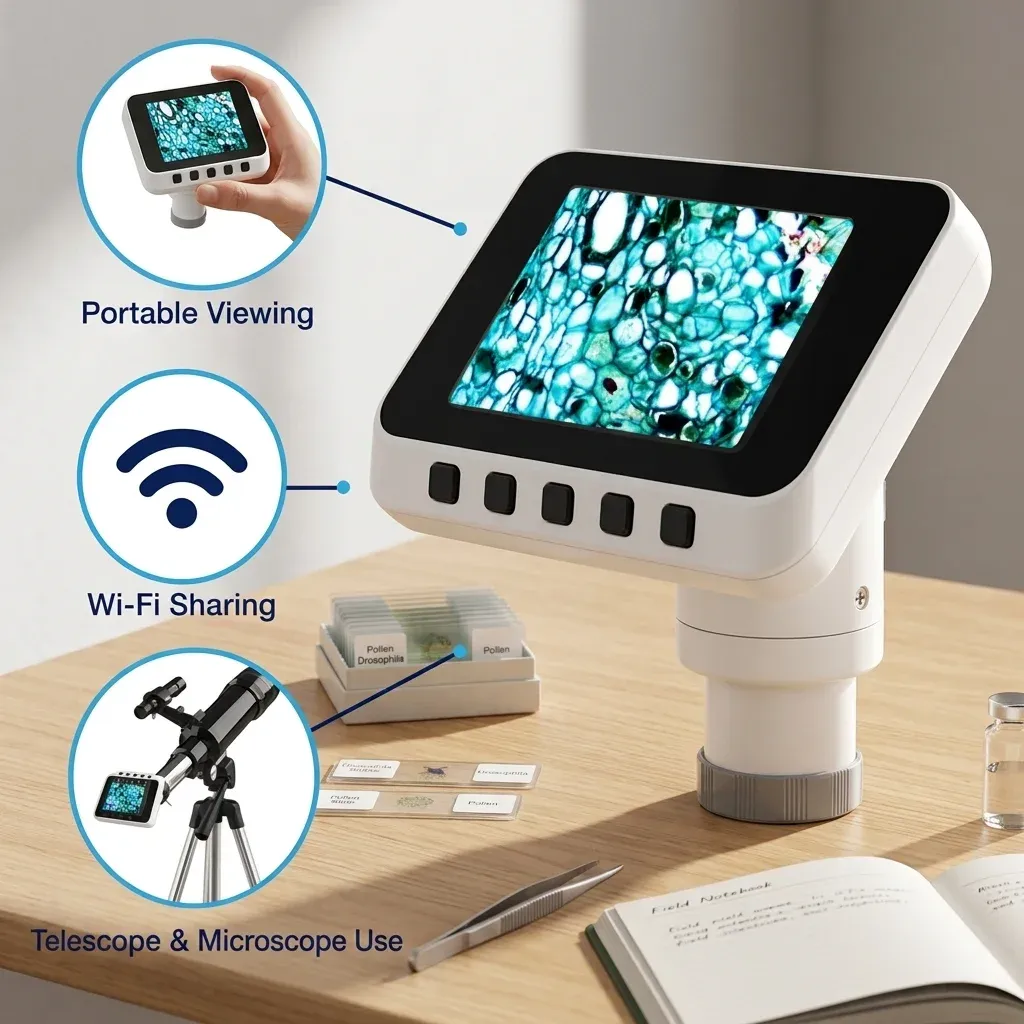
A digital eyepiece camera is a camera that fits into, or in place of, a microscope or telescope eyepiece so you can view, save and share what the optics see on a screen instead of relying only on direct viewing. For UK buyers, it is most useful when you want easier group viewing, simple image capture and a tidier workflow than balancing a phone over the lens.
TL;DR: A digital eyepiece camera lets you turn a microscope, telescope or compatible scope into a digital viewing system for lessons, hobby use and inspection work. Based on our testing of common wireless eyepiece-style setups, the most important checks are fitting size, image quality, screen usability, WiFi reliability, battery life and compatibility with your instrument. In short, if you need straightforward live viewing and image capture in a classroom, workshop or at home, a digital eyepiece camera is often the easiest option.
WifiElectr’s positioning is clear: The Ultimate WiFi Electronic Eyepiece Camera. However, the appeal is not just image capture. It is the combination of wireless viewing, a built-in 2.8-inch display and straightforward compatibility with common microscope and telescope setups. Therefore, in UK buying terms, the focus should stay on usability, fitting size, image quality and whether the device suits the way you actually work.
This guide explains what a digital eyepiece camera is, how it differs from other camera types, what specifications matter before you buy, and where it makes sense in British classrooms, labs, workshops and home observation setups.
Key Takeaways
- A digital eyepiece camera fits into or replaces an eyepiece position on a microscope or telescope so you can view and capture images digitally.
- For UK buyers, the most important checks are tube size compatibility, sensor resolution, screen or software workflow, power options and operating system support.
- Wireless models with a built-in display reduce cable clutter and make group viewing easier in classrooms, STEM clubs and outreach settings.
- They are especially useful for microscopy, basic astrophotography, bird watching at distance and technical inspection work.
- If you need broader microscope-specific background, read The Ultimate Guide to Microscope Eyepiece Camera in the UK.
What is a digital eyepiece camera?
A digital eyepiece camera is a compact imaging device designed to sit where an eyepiece would normally go, or to connect directly through an eyepiece tube or adapter. Instead of relying only on direct visual observation through glass optics, it converts the optical image into a digital feed that can be viewed on a screen, recorded as stills or video and, in some cases, shared wirelessly.
In practical terms, this means one person no longer has to be the only person who can see the specimen or subject clearly. For example, a teacher can project microscope footage to a class. Likewise, a hobbyist can capture observations without pressing a smartphone awkwardly against the lens. A technician can also save reference images for inspection records.
How is a digital eyepiece camera different from using your phone?
Phone adapters can work for occasional use, but they often struggle with alignment, vibration and repeatability. By contrast, a proper digital eyepiece camera gives you a more stable optical path, more predictable framing and an easier workflow for saving images. In addition, wireless units with onboard screens mean you do not always need to tether the instrument to a laptop just to check focus and composition.
How is a digital eyepiece camera different from an astronomy camera?
A dedicated astronomy imaging camera usually assumes a more advanced telescope setup and often requires extra software knowledge. A digital eyepiece camera is generally easier to fit and easier to use for mixed-purpose viewing. So if your priority is accessible observation rather than highly specialised deep-sky imaging, the eyepiece format often makes more sense. Buyers focused on telescope use may also want to compare this guide with Wireless Telescope Camera Explained: A UK Buyer's Guide.
Why are UK buyers choosing digital eyepiece cameras?
The strongest reason is convenience. British schools, clubs and households often want equipment that works across several tasks without needing specialist imaging knowledge. As a result, one unit that supports STEM education, hobby microscopy and casual telescope viewing can offer better value than assembling multiple accessories.
The education angle is especially relevant. According to UK Government school statistics published via GOV.UK, England has thousands of state-funded secondary schools and millions of pupils in compulsory education each year. Consequently, there is ongoing demand for practical classroom tools that help teachers demonstrate scientific concepts clearly.
For schools working within tight budgets, being able to share one live image across multiple students improves lesson delivery without every pupil needing their own instrument station. Similarly, for after-school clubs and outreach groups, wireless display reduces setup friction.
Why are they useful in STEM education?
A biology department can display prepared slides without queuing every pupil at one microscope. An engineering or electronics club can examine circuit boards during soldering practice. In both cases, quick setup matters almost as much as raw resolution.
Why are they useful for field and hobby observation?
Bird watchers using spotting scopes or users observing distant subjects appreciate being able to check framing on-screen rather than staying fixed to the eyecup. Amateur astronomers also benefit when showing targets such as the Moon or bright planets to family members or club visitors.
Why are they useful in inspection environments?
Small workshops and bench-based quality control setups often need documentation rather than gallery-grade imagery. Therefore, a digital eyepiece camera lets teams record findings consistently while keeping the optical workflow simple.
What can you use a digital eyepiece camera for?
The term covers more than one use case; therefore buying successfully depends on matching the device to your main task.
Can you use a digital eyepiece camera with a microscope?
- School biology lessons
- Home science projects
- Entomology and specimen study
- Coin grading and surface examination
- Solder inspection and small-part checking
Can you use a digital eyepiece camera with a telescope?
- Lunar viewing
- Basic planetary observation
- Astronomy outreach sessions
- Shared family viewing without constant refocusing at the eye lens
Can you use a digital eyepiece camera for bird watching or nature observation?
- Bird watching through compatible scopes
- Distant landscape detail review
- Educational demonstrations outdoors
If your main interest sits specifically between telescopes and image capture, see also Astrophotography Eyepiece Camera Explained: A UK Buyer's Guide. For microscope-led buying criteria in more depth, revisit our pillar resource: The Ultimate Guide to Microscope Eyepiece Camera in the UK.
What should you look for before buying a digital eyepiece camera?
1. Will it fit your microscope or telescope?
This is the first check because even excellent specifications are irrelevant if the unit does not fit your instrument properly. Based on our testing of entry-level and mid-range setups commonly used in the UK, buyers should confirm tube diameter requirements first and then check whether any adapter sleeves are included for standard sizes.
If you are buying for a school lab or shared workshop bench in particular situations where several instruments may be used interchangeably it helps to choose an option that supports common fittings rather than something highly specialised.
2. How much resolution do you actually need?
. Is built-in screen useful?
Ready to try WifiElectr?
Shop Now — £43.19